
Kyrgyz Gardener Who Turned Rocky Land into an Orchard
The Apricot Valley
Located in southwestern Kyrgyzstan, about 1,000 kilometers from the country’s capital Bishkek, the Batken region borders Uzbekistan and Tajikistan. The area suffers from a shortage of irrigation water, and its land is largely rocky. However, thanks to its sunny climate, it is well suited to horticulture – the cultivation of various fruits.
The region is also known as the Apricot Valley. Apricots are Batken’s main hallmark. Since ancient times, Batken has been famous not only throughout Kyrgyzstan but across the entire Central Asian region for its exceptionally sweet apricots.
From Idea to Orchard Project
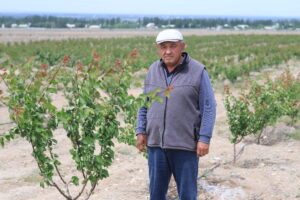
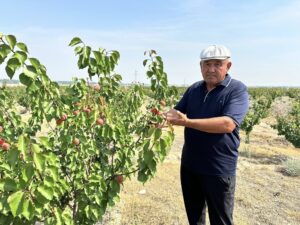
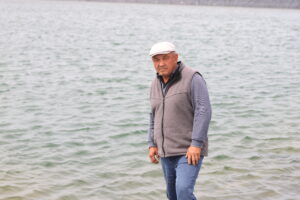
In recent years, local gardeners have moved beyond apricots, learning to cultivate other fruit-bearing trees such as cherries and peaches. Among them is Tolubai Jalilov, a 58-year-old resident of Kyrgyz-Kyshtak village in the Kadamjay District, which lies along the border with Uzbekistan.
Jalilov has devoted his life to horticulture, working for about 35 years in a state-run farm. In the Burgondu area where he lives, irrigation water remains scarce, and large stretches of land lie barren and unused because of the lack of water.
Whenever Tolubai Jalilov looked at the parched, rocky fields, he would think: “If only there were water, we could turn these lands into orchards and make them bloom.”
Driven by his passion for gardening, he eventually decided to reclaim part of the abandoned land himself and set out to establish a large orchard. Around that time, drip irrigation was also beginning to be introduced in Kyrgyzstan, although only on a limited scale. Jalilov chose to address the irrigation challenge using this method.
To turn this dream into reality, Jalilov began mastering modern horticultural techniques, deepening his knowledge through both study and hands-on practice. He started by purchasing one or two dwarf and semi-dwarf saplings of various fruit trees, imported from nearby and distant countries, and planted them on his plot as a trial.
The experiment proved highly successful: all the saplings began bearing fruit within just one year. Encouraged by the results, the gardener brought his family together, shared his vision of establishing an orchard across several hectares, and discussed practical ways to realize this plan.
Of course, this required significant financial resources at the outset. The gardener explained to his children that if they could endure the difficulties for four to five years, the situation would eventually improve, and once the orchard began to bear fruit, it would become a reliable source of income for the family.
During a family council, it was decided that, in order to secure the initial funds for the project, the two eldest sons – already with families of their own-would go to work abroad with their spouses. To accompany and support them, the family matriarch, the mother, also joined them. Thus, a group of five set off for Russia, where many people from the region were then seeking employment, all in support of Jalilov’s vision of establishing a large orchard.
Once Tolubai Jalilov had accumulated sufficient funds to begin the project, he called his wife, sons, and daughters-in-law back from labour migration. This stage of preparation lasted a full five years.
Life in a Water-Scarce Landscape and Early Success
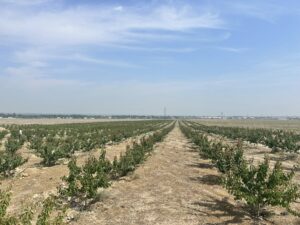
At the beginning of 2025, he leased 20 hectares of previously unused, rocky land from the local village administration on a long-term basis. However, the agreement included a condition that if the land was not developed within two years, it would be reclaimed by the authorities, requiring immediate work to begin.
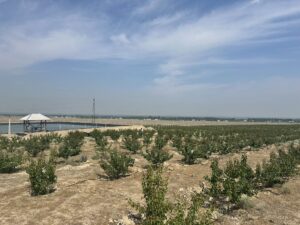
By that time, Tolubai Jalilov had already searched online and engaged architects from the Czech Republic to design a water reservoir (BSR). Construction began without delay based on their plans. While it was still underway, he also drilled a 150-meter-deep well to access groundwater.
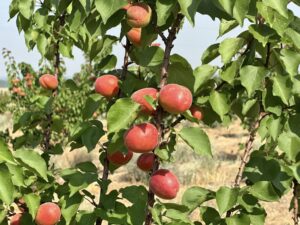
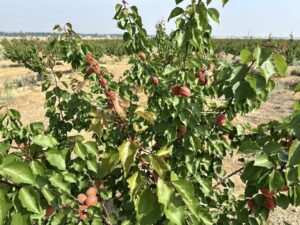
He then fenced off the entire 20-hectare area. By spring, the land had been leveled and prepared for planting. When the season arrived, he planted apricot and cherry saplings imported from Turkey – a total of 4,000 semi-dwarf trees. At the same time, a drip irrigation system was installed immediately.
All of the work was carried out under the supervision of relevant specialists and in strict compliance with agrotechnical requirements. As a result, almost all of the planted saplings took root and, even in the first year, began to produce a modest harvest.
“I posted photos of that first harvest on social media, and many people were surprised by the size and quality of the fruit. Experienced gardeners from neighbouring regions of Uzbekistan, who had been engaged in horticulture for many years, even came to see it for themselves. They initially suspected the images might have been edited in Photoshop, but were astonished to find that everything was real,” says Tolubai Jalilov.
According to him, a representative of the Turkish company supplying the saplings also visited the orchard and described it as having “the best performance indicators.”
“They usually stay in contact with customers who purchase large quantities of saplings. Last year, an agronomist from that company came specifically to observe our work. After inspecting the orchard and assessing the growth and overall condition of the trees, he said such results are rare among their clients and described our work as a highly successful start,” explains the gardener.
This year (2026), Tolubai Jalilov again purchased and planted 9,200 saplings from the same Turkish company, fully developing the 20-hectare plot. Including last year’s planting, a total of 13,200 saplings have now been established on the site.
To realize his long-standing dream of creating a large orchard, the gardener supplemented the funds earned by his family through labour migration with a small soft loan. According to his estimates, all expenses will be fully recovered within five years, after which the project is expected to begin generating net profit.
Speaking of profit, last year he was able to bring a small portion of his initial harvest to the domestic market, earning a modest income. Seeing the quality of the produce, local logistics companies, with an eye on export opportunities, had already placed advance orders and reserved the harvest for the following year. Thus, the issue of selling the ripe fruit was effectively resolved in advance.
A Hidden Secret in the Roots
Gardener Tolubai Jalilov attributes his rapid success to work carried out under the supervision of a qualified agronomist and in strict compliance with agrotechnical standards. He emphasizes that the most important factor was the proper selection of rootstock for the saplings.
He therefore urges other gardeners seeking success in orchard farming to pay close attention to the quality and condition of sapling root systems.
“Horticulture is nothing new to our Batken region. The 100- and 200-year-old apricot trees planted by our ancestors are still bearing fruit today. However, the methods they used have become outdated. We must adopt modern approaches in line with current requirements. Instead of relying on old varieties, we should transition to improved cultivars that produce higher-quality and more flavorful fruit. We should also develop our own local nurseries instead of depending solely on imported saplings. This requires the involvement of scientists and breeders, as well as serious, systematic attention,” the gardener notes.
Climate Change That Cannot Be Ignored
Kyrgyzstan’s Batken Region lies within the Fergana Valley of Central Asia. The valley is among the most densely populated areas in the world, with an average population density of 200–500 people per square kilometer. It spans three regions of Kyrgyzstan (Osh, Jalal-Abad, and Batken), three regions of Uzbekistan (Namangan, Andijan, and Fergana), and the Sughd Region of Tajikistan, with a total population estimated at around 18 million.
Climate change has also had a noticeable impact on the area. In recent years, winter snowfall has sharply decreased, with snow falling only two to three times per season at most. Overall precipitation has declined by about 40 percent. During the summer months, temperatures regularly reach around 40°C. In most parts of the valley, irrigation water has become increasingly scarce.
Tolubai Jalilov notes that recent climate change is already having a visible impact on horticulture in the region.
“In recent years, spring has been arriving 10-15 days earlier than usual. However, this does not mean stable warmth. When trees begin to bud or bloom, the weather can suddenly turn sharply cold. In such cases, the blossoms are damaged by frost, and the trees fail to bear fruit that year. Conversely, there are also periods of extreme heat, when the blossoms are scorched, and again there is no harvest.”
Such fluctuations have become increasingly common in Batken in recent years, clearly indicating that horticulture requires a different approach. Based on his experience, Jalilov argues that the way forward lies in the use of new, properly selected saplings.
“Saplings that have undergone laboratory testing are better adapted to both cold and heat stress,” he explains.
Therefore, gardener Tolubai Jalilov urges other growers to adapt to modern requirements and adopt new technologies in horticulture. He believes that such a shift would allow farmers – and the wider population – to significantly increase their income from fruit cultivation compared to current levels.
The Batken region of Kyrgyzstan has around 10,000 hectares of apricot orchards, where more than 20 varieties are cultivated. Provided that weather conditions do not damage the bloom, the region generates approximately 15 billion Kyrgyz som (KGS)-about 170 million USD -in annual income from apricot production.
The Impact of Drip Irrigation
Tolubai Jalilov considers the drip irrigation system to be the most important factor in orchard farming. First, it is highly efficient for irrigating orchards, as the dripping water reaches the roots of each plant. It is only necessary to supply it at the right time and in the required amount. Second, this system also makes it convenient to provide plants with necessary vitamins and nutrients in a timely manner.
Most importantly, water is not wasted unnecessarily. If the same area were irrigated using traditional canal irrigation, a large amount of water would simply flow away into the fields. Therefore, the farmer advises everyone engaged in gardening to accept a small cost and switch to drip irrigation.
As a result, many people now come to him for advice from his own village, other districts, and even nearby regions of Uzbekistan. In this year (2026), at the request of regional authorities, he conducted a training session on drip irrigation for gardeners in his orchard and shared his experience.
According to relevant agricultural officials of the Batken region, the number of farmers switching to drip irrigation in the region has been increasing year by year due to the efforts of proactive orchard growers such as Tolubai Jalilov. In 2026 alone, an additional 933 hectares of land are expected to be brought under drip irrigation systems. These areas, being rocky and water-scarce, had previously remained undeveloped.
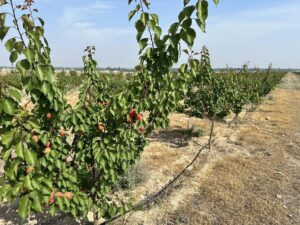
The development of land through drip irrigation is being implemented within the framework of the project “Creating a Framework for the Wide Implementation of Energy Innovations in Agricultural Systems.” Under the project, 345 hectares in Kadamjay district, 340 hectares in Batken district, and 100 hectares of dry, rocky land in Leylek district will be converted into arable farmland. In addition, 138 hectares in Batken city and 10 hectares in Kyzyl-Kyya city will be greened through the drip irrigation system.
According to specialists, the drip irrigation system enables efficient use not only of water but also of mineral fertilizers and human labor. This is considered one of the essential measures, particularly in regions of the country facing irrigation water shortages.
The Ministry of Water Resources, Agriculture and Processing Industry of Kyrgyz Republic has repeatedly warned about water shortages and continues to call on farmers to adopt water-saving irrigation methods, including drip and sprinkler irrigation.
According to the ministry, drip and sprinkler irrigation systems are currently in use on 16,000 hectares across Kyrgyzstan (as of 2026). The government plans to expand these systems to 200,000 hectares by 2030. It has also been reported that state funding is being allocated for the development of drip and sprinkler irrigation systems, and that preferential loans are available for farmers who wish to adopt these technologies.
According to the United Nations Food and Agriculture Organization, natural water replenishment in Central Asia has decreased by 12 percent since 2015. In this context, the transition to drip irrigation is considered one of the most urgent measures in the region.
Shaiyrbek Mukaramov, KAIEJA Board member
Notes:
The article was published in May 2026.
The photos were provided by Ruslan Tolubayev and the Batken Regional Administration.



